Incubators & Hatching
Brinsea vs. Nurture Right 360 vs. Magicfly Incubator
- All three are forced-air, which is the single biggest factor in beginner-friendliness — a fan removes the temperature layering that trips up still-air incubators.
- Capacity runs in the opposite direction from price: Brinsea (most expensive) holds only 7 eggs, Nurture Right 360 (mid-tier) holds up to 22, Magicfly (cheapest) holds 9-12.
- Magicfly's mini model can't have its auto-turn switched off — the tray can only be removed or repositioned. Brinsea and Nurture Right 360 both auto-stop turning automatically before hatch.
- Brinsea's reputation edge is real (a long-standing, trusted brand for hatch reliability) but it comes with the smallest batch size of the three — not the pick if you want to hatch a lot of eggs at once.
These are the three incubators that show up most often against each other in beginner-hatcher discussions, compared directly rather than folded into a wider roundup. All three specs below come from the same product data behind our full beginner incubator guide — manufacturer documentation and product listings, cross-checked against each other, including Magicfly's auto-turn behavior against the manufacturer's own published FAQ rather than assumed.
At a glance

Magicfly Digital Incubator
Beginners testing the hobby on the smallest possible budget before committing to a bigger incubator.
Check Price on Amazon
Nurture Right 360 (Harris Farms)
Beginners who want a larger first batch (up to 22 eggs) than a mini incubator allows, without paying Brinsea's premium.
Check Price on Amazon
Brinsea Mini II Advance
First-time hatchers who want the most forgiving, best-documented experience and are hatching in small batches — not the pick if you want to hatch a large batch at once.
Check Price on AmazonFull spec comparison
| Incubator | Price tier | Air type | Capacity | Auto-turn | Check price |
|---|---|---|---|---|---|
 Brinsea Mini II Advance Brinsea Mini II Advance | $$$ | Forced air (fan-assisted circulation) | 7 standard eggs, or 12 small eggs with the optional insert | Yes — turning interval and angle are programmable; stops automatically 2 days before hatch | Check Price |
 Nurture Right 360 (Harris Farms) Nurture Right 360 (Harris Farms) | $$ | Forced air (integrated circulation fan) | Up to 22 chicken eggs (12-18 duck eggs, 22-24 pheasant eggs) | Yes — every 2 hours, with auto-stop 3 days before hatch | Check Price |
 Magicfly Digital Incubator Magicfly Digital Incubator | $ | Forced air (fan-assisted circulation) | 9-12 eggs (mini model); larger 24-egg and 40-egg models also sold under the same name | Yes — the turner tray can be removed or repositioned (e.g. for lockdown), but there's no on/off switch on this mini model | Check Price |
Capacity vs. price: the real tradeoff
The clearest pattern across these three isn't power features or brand reputation — it's that capacity and price move in opposite directions. Brinsea, the most expensive of the three, holds only 7 standard eggs (12 with an optional insert for small eggs). Magicfly, the cheapest, holds 9-12 eggs in its mini model. Nurture Right 360 sits in the middle on price and comes out ahead on capacity, holding up to 22 chicken eggs. That's not a contradiction — Brinsea's price buys a more forgiving, fully programmable turning system, not more room. If batch size is your main constraint (you want to hatch a dozen-plus eggs at once), Nurture Right 360's capacity is the real differentiator here, not price alone.
On hatch-rate expectations specifically: our beginner incubator guide covers the general hatch-rate ranges for forced-air incubators like all three of these, and none of the three publishes its own model-specific hatch-rate guarantee. Price tier doesn't map cleanly onto hatch rate on its own — the biggest real-world factors are fertile egg quality and how consistently you hold temperature and humidity, not which of these three you buy. Where price tier does matter is in removing manual failure points: Brinsea's automatic pre-hatch turning stop and Nurture Right 360's auto-stop both take "forgot to disable the turner before lockdown" off the table, a mistake that can cost a hatch regardless of price paid for the unit. Magicfly's mini model has no auto-turn switch at all (see below), so getting lockdown timing right depends on remembering to remove or reposition the tray yourself.
The incubators, one by one
Brinsea Mini II Advance — $$$
Most trusted brand
Trusted premium brand, forced-air, fully programmable auto-turn, strong reputation for hatch reliability. Small batch size (7 eggs) is the tradeoff for that reliability.
- Air type: Forced air (fan-assisted circulation)
- Capacity: 7 standard eggs, or 12 small eggs with the optional insert
- Auto-turn: Yes — turning interval and angle are programmable; stops automatically 2 days before hatch
- Forced-air circulation is the more forgiving, beginner-friendly airflow type — see the air-type section below
- Fully programmable auto-turn with an automatic pre-hatch stop, so you can't forget to disable it
- Digital countdown display removes the guesswork of tracking incubation day-by-day
- Long-standing, trusted brand reputation for hatch reliability
- Most expensive of the three by a wide margin
- Small 7-egg capacity limits how many chicks you can hatch per cycle
- Humidity is manual (external water-tray top-up), not automatically controlled
Ideal for: First-time hatchers who want the most forgiving, best-documented experience and are hatching in small batches — not the pick if you want to hatch a large batch at once.
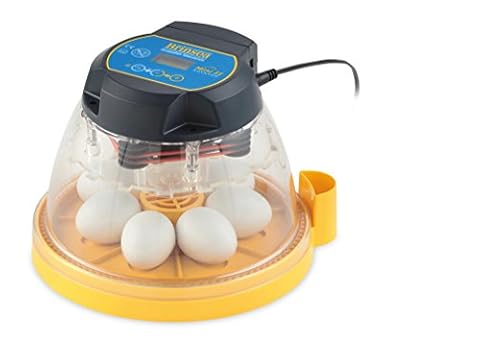
Brinsea Mini II Advance
Incubator
$$$ see current price on Amazon
Trusted premium brand, forced-air, fully programmable auto-turn, strong reputation for hatch reliability. Small batch size (7 eggs) is the tradeoff for that reliability.
Check Price on Amazon (paid link)
Nurture Right 360 (Harris Farms) — $$
Most popular beginner pick
Popular beginner pick, forced-air, 22-egg capacity, clear 360° viewing dome, widely reviewed. Some owners report needing to calibrate the temperature reading against an external thermometer.
- Air type: Forced air (integrated circulation fan)
- Capacity: Up to 22 chicken eggs (12-18 duck eggs, 22-24 pheasant eggs)
- Auto-turn: Yes — every 2 hours, with auto-stop 3 days before hatch
- 22-egg capacity is a real step up from the budget mini incubators without reaching Brinsea's price
- Digital temperature and humidity display with a built-in calibration function
- 360° clear dome for full visibility without opening the incubator
- Widely reviewed — one of the most commonly recommended first incubators in beginner communities
- Some owners report the temperature gauge reading inaccurately out of the box and needing calibration against an external thermometer
- Humidity control is manual (a knob), not automatic
Ideal for: Beginners who want a larger first batch (up to 22 eggs) than a mini incubator allows, without paying Brinsea's premium.

Nurture Right 360 (Harris Farms)
Incubator
$$ see current price on Amazon
Popular beginner pick, forced-air, 22-egg capacity, clear 360° viewing dome, widely reviewed. Some owners report needing to calibrate the temperature reading against an external thermometer.
Check Price on Amazon (paid link)
Magicfly Digital Incubator — $
Lowest price
Budget entry point, forced-air despite the low price, huge Amazon review volume, good for "for the money" searches.
- Air type: Forced air (fan-assisted circulation)
- Capacity: 9-12 eggs (mini model); larger 24-egg and 40-egg models also sold under the same name
- Auto-turn: Yes — the turner tray can be removed or repositioned (e.g. for lockdown), but there's no on/off switch on this mini model
- Cheapest of the three, with huge Amazon review volume to cross-check
- Forced-air despite the low price — not a stripped-down still-air unit
- LED display shows temperature, turn timing, humidity, and days remaining together
- Smallest standard capacity (9-12 eggs) of the three at this size — the larger 24/40-egg Magicfly models are separate purchases
- Budget build quality — less established reliability track record than Brinsea
Ideal for: Beginners testing the hobby on the smallest possible budget before committing to a bigger incubator.

Magicfly Digital Incubator
Incubator
$ see current price on Amazon
Budget entry point, forced-air despite the low price, huge Amazon review volume, good for "for the money" searches.
Check Price on Amazon (paid link)
Auto-turn behavior
Manual turning demands 3-5+ precisely-timed sessions a day for 18 straight days, so auto-turn is worth understanding in detail rather than treating as a simple checkbox feature:
| Incubator | Turn interval | Can it be switched off? | Pre-hatch stop |
|---|---|---|---|
| Brinsea Mini II Advance | Programmable (interval and angle both adjustable) | Not specified as a manual on/off switch in manufacturer documentation — "programmable" refers to interval/angle settings, not a stated ability to disable turning entirely | Automatic, 2 days before hatch |
| Nurture Right 360 | Every 2 hours | Not specified as adjustable in manufacturer documentation | Automatic, 3 days before hatch |
| Magicfly Digital Incubator (mini) | Not specified by manufacturer | No — manufacturer's own FAQ for this model states the turner can't be switched off, only the tray removed or repositioned | Not stated as an automatic feature — manufacturer FAQ only describes removing or repositioning the tray, e.g. near lockdown |
Which incubator should you buy?
Frequently asked questions
What's the actual difference between these three incubators, besides price?
Mostly capacity and turning behavior. Magicfly's mini model holds 9-12 eggs and its turner tray can be removed or repositioned but has no on/off switch. Nurture Right 360 holds up to 22 chicken eggs and turns automatically every 2 hours with an auto-stop 3 days before hatch. Brinsea's Mini II Advance holds only 7 standard eggs but has the most fully programmable auto-turn of the three — adjustable interval and angle, with an automatic pre-hatch stop. All three are forced-air, which matters more for beginner success than any of these individual differences.
Which of these three has the biggest capacity?
The Nurture Right 360, at up to 22 chicken eggs (12-18 for the larger duck eggs, or 22-24 for the smaller pheasant eggs). That's a real step up from Magicfly's 9-12 egg mini model without reaching Brinsea's price tier — though Brinsea's small 7-egg capacity is a deliberate tradeoff for its more forgiving, fully programmable auto-turn.
Can I turn the eggs manually with any of these, or does auto-turn have to run the whole time?
It depends on the model. Brinsea's auto-turn is programmable and stops automatically 2 days before hatch, so you don't have to remember to disable it. Nurture Right 360 turns every 2 hours with auto-stop 3 days before hatch. Magicfly's mini model is the exception: its manufacturer FAQ states the turner can't be switched off — the tray can only be removed or repositioned, for example during lockdown near hatch day — so manual-only turning isn't really an option on this specific model the way it might be assumed.
Which is cheapest, and is it worth buying the cheapest one?
Magicfly's mini model is the cheapest of the three by a wide margin, and it's still forced-air despite the low price — not a stripped-down still-air unit. The tradeoff is the smallest capacity (9-12 eggs) and a less established reliability track record than Brinsea. It's a reasonable way to test the hobby on a small budget before committing to a bigger incubator, not a reason to expect Brinsea-level consistency.