Incubators & Hatching
Best Chicken Egg Incubators for Beginners
- Hatch rates vary with fertility, egg handling, and incubation conditions; no model guarantees a result.
- All three models listed use forced-air circulation; temperature stability and correct setup still matter.
- Automatic turning can reduce daily handling, but verify each model?s turner and lockdown instructions.
- Choose capacity only after planning brooder space, long-term care, and a responsible plan for every chick.
- Magicfly is the budget option, Nurture Right offers the largest stated chicken capacity, and Brinsea is the premium small-batch model.
All three of the chicken incubators below are small, forced-air tabletop models — 7 to 22 eggs — and none of them is chicken-specific hardware. They're general-purpose poultry incubators that happen to be sized and marketed for a first chicken hatch, which is why capacity and airflow matter more here than any brand claim.
This guide compares published product specifications and extension guidance; we have not run a controlled hatch test with these models. Read the current manual before setting eggs, since controls and instructions can change by model revision.
Set your expectations honestly: hatch rates vary
There is no single hatch-rate percentage that is a fair expectation for every first hatch. Results depend on fertility, breeder and egg handling, storage time, shipping, temperature, humidity, ventilation, and turning. Keep a simple record of eggs set, candling observations, clears, late losses, and chicks hatched. That can help distinguish an infertile or damaged batch from an equipment or management issue. A product's capacity is not a hatch-rate guarantee.
What to actually look for
- Turning that fits your routine. Automatic turning reduces daily handling, but check its schedule and lockdown procedure. USU Extension recommends an automatic turner and stopping turns before hatch; follow your model's manual for exact timing.
- Air circulation and stable temperature. These three models are fan-assisted. Put the incubator in a stable room away from drafts, direct sun, and heaters; verify readings using the method recommended by the manual.
- Capacity you can responsibly raise. Decide how many chicks your brooder, coop, local rules, and flock plan can accommodate. Plan for all hatchlings rather than assuming a particular hatch percentage or sex ratio.
- A humidity plan. Brinsea and Nurture Right list manual humidity management. Do not assume a displayed humidity number is calibrated; follow the maker's method and monitor as its instructions direct.
Before you buy: a first-hatch readiness check
An incubator is only one part of hatching. Confirm you have a source of fertile eggs and know how they were collected, stored, and shipped. Set up and test the incubator empty before eggs arrive so you can learn its controls and see whether readings remain stable. Have a clean, draft-free place for the machine, reliable power, and a backup plan if outages are likely.
Plan the brooder before setting eggs: heat source, safe bedding, chick starter, clean water, and enough protected space. Arrange a lawful, humane plan for cockerels and any chicks you cannot keep. If you cannot house or place every chick, postpone the hatch rather than treating maximum capacity as a target.
USU Extension's hatching and chick-care guide covers temperature, turning, lockdown, and brooder planning. Mississippi State Extension's hatching quality chicks guide covers egg storage, ventilation, and power-outage guidance. Use these alongside the current manual for your exact model.
Quick-pick comparison
| Incubator | Air type | Capacity | Auto-turn | Price tier | Check price |
|---|---|---|---|---|---|
 Brinsea Mini II Advance Brinsea Mini II Advance | Forced air (fan-assisted circulation) | 7 standard eggs, or 12 small eggs with the optional insert | Yes — turning interval and angle are programmable; stops automatically 2 days before hatch | $$$ | Check Price |
 Nurture Right 360 (Harris Farms) Nurture Right 360 (Harris Farms) | Forced air (integrated circulation fan) | Up to 22 chicken eggs (12-18 duck eggs, 22-24 pheasant eggs) | Yes — every 2 hours, with auto-stop 3 days before hatch | $$ | Check Price |
 Magicfly Digital Incubator Magicfly Digital Incubator | Forced air (fan-assisted circulation) | 9-12 eggs (mini model); larger 24-egg and 40-egg models also sold under the same name | Yes — the turner tray can be removed or repositioned (e.g. for lockdown), but there's no on/off switch on this mini model | $ | Check Price |
Incubators, one by one
Brinsea Mini II Advance — $$$
Most trusted brand
Trusted premium brand, forced-air, fully programmable auto-turn, strong reputation for hatch reliability. Small batch size (7 eggs) is the tradeoff for that reliability.
See how it stacks up directly against the other two in our Brinsea vs. Nurture Right vs. Magicfly comparison.
- Air type: Forced air (fan-assisted circulation)
- Capacity: 7 standard eggs, or 12 small eggs with the optional insert
- Auto-turn: Yes — turning interval and angle are programmable; stops automatically 2 days before hatch
- Forced-air circulation is the more forgiving, beginner-friendly airflow type — see the air-type section below
- Fully programmable auto-turn with an automatic pre-hatch stop, so you can't forget to disable it
- Digital countdown display removes the guesswork of tracking incubation day-by-day
- Long-standing, trusted brand reputation for hatch reliability
- Most expensive of the three by a wide margin
- Small 7-egg capacity limits how many chicks you can hatch per cycle
- Humidity is manual (external water-tray top-up), not automatically controlled
Ideal for: First-time hatchers who want the most forgiving, best-documented experience and are hatching in small batches — not the pick if you want to hatch a large batch at once.
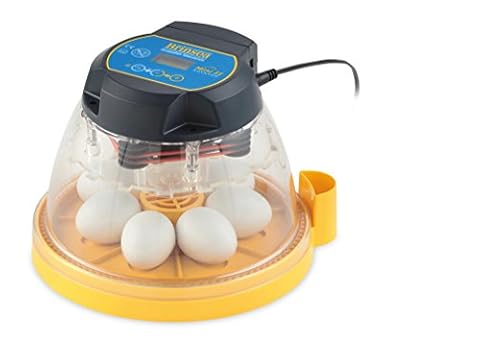
Brinsea Mini II Advance
Incubator
$$$ see current price on Amazon
Trusted premium brand, forced-air, fully programmable auto-turn, strong reputation for hatch reliability. Small batch size (7 eggs) is the tradeoff for that reliability.
Check Price on Amazon (paid link)
Nurture Right 360 (Harris Farms) — $$
Most popular beginner pick
Popular beginner pick, forced-air, 22-egg capacity, clear 360° viewing dome, widely reviewed. Some owners report needing to calibrate the temperature reading against an external thermometer.
See how it stacks up directly against the other two in our Brinsea vs. Nurture Right vs. Magicfly comparison.
- Air type: Forced air (integrated circulation fan)
- Capacity: Up to 22 chicken eggs (12-18 duck eggs, 22-24 pheasant eggs)
- Auto-turn: Yes — every 2 hours, with auto-stop 3 days before hatch
- 22-egg capacity is a real step up from the budget mini incubators without reaching Brinsea's price
- Digital temperature and humidity display with a built-in calibration function
- 360° clear dome for full visibility without opening the incubator
- Widely reviewed — one of the most commonly recommended first incubators in beginner communities
- Some owners report the temperature gauge reading inaccurately out of the box and needing calibration against an external thermometer
- Humidity control is manual (a knob), not automatic
Ideal for: Beginners who want a larger first batch (up to 22 eggs) than a mini incubator allows, without paying Brinsea's premium.

Nurture Right 360 (Harris Farms)
Incubator
$$ see current price on Amazon
Popular beginner pick, forced-air, 22-egg capacity, clear 360° viewing dome, widely reviewed. Some owners report needing to calibrate the temperature reading against an external thermometer.
Check Price on Amazon (paid link)
Magicfly Digital Incubator — $
Lowest price
Budget entry point, forced-air despite the low price, huge Amazon review volume, good for "for the money" searches.
See how it stacks up directly against the other two in our Brinsea vs. Nurture Right vs. Magicfly comparison.
- Air type: Forced air (fan-assisted circulation)
- Capacity: 9-12 eggs (mini model); larger 24-egg and 40-egg models also sold under the same name
- Auto-turn: Yes — the turner tray can be removed or repositioned (e.g. for lockdown), but there's no on/off switch on this mini model
- Cheapest of the three, with huge Amazon review volume to cross-check
- Forced-air despite the low price — not a stripped-down still-air unit
- LED display shows temperature, turn timing, humidity, and days remaining together
- Smallest standard capacity (9-12 eggs) of the three at this size — the larger 24/40-egg Magicfly models are separate purchases
- Budget build quality — less established reliability track record than Brinsea
Ideal for: Beginners testing the hobby on the smallest possible budget before committing to a bigger incubator.

Magicfly Digital Incubator
Incubator
$ see current price on Amazon
Budget entry point, forced-air despite the low price, huge Amazon review volume, good for "for the money" searches.
Check Price on Amazon (paid link)
Beginner mistakes to avoid
- Skipping the empty test run. Learn how temperature and humidity behave before eggs are inside. Keep the incubator level and use its calibration instructions.
- Treating one humidity number as universal. Design, measurement method, room conditions, and egg development matter. Follow the manual and egg supplier rather than copying a percentage from an unrelated model.
- Opening the incubator repeatedly during hatch. Follow the machine's lockdown instructions; frequent opening can disrupt conditions.
- Improvising during a power outage. Have a backup and response plan before incubation begins; ventilation advice differs for forced-air and still-air units.
- Waiting until hatch day to set up chick care. Prepare brooder heat, feed, water, and space before setting eggs.
What to do on hatch day
For chicken eggs, turning typically stops around day 18, about three days before expected hatch. Follow the incubator manual for removing or disabling the turner and adjusting humidity and ventilation. Keep the lid closed as directed during hatch; repeated opening can disrupt conditions. Hatch timing varies, so allow for normal variation rather than intervening simply because a chick has not emerged on the expected day.
Frequently asked questions
What hatch rate should a beginner expect?
There is no dependable percentage that applies to every batch. Fertility, breeder flock, egg handling and storage, shipping, and incubation conditions all affect results. Record eggs set, candling observations, clears, losses, and chicks hatched; this helps assess a specific batch without promising a result an incubator cannot guarantee.
Is automatic egg turning worth it?
It can reduce daily work and missed turns, but check the exact model's turning schedule and lockdown procedure. Follow the manual and egg supplier's instructions; an automatic turner does not control temperature or humidity. All three models listed here include a turning mechanism.
Still-air or forced-air: which should I choose?
A fan circulates air and reduces temperature layering. Still-air machines need their own temperature targets and thermometer placement. These three listed models are fan-assisted; use the exact model's manual for setup and calibration.
Can these incubators hatch duck, quail, or other poultry eggs?
Tray fit, turning, temperature, humidity, and incubation duration vary by species. Nurture Right 360 lists separate chicken, duck, and pheasant capacities; Brinsea lists standard and small egg capacity; Magicfly's mini listing does not give comparable species-specific capacity. Check the current manual for your species and avoid mixing species with different incubation periods in a first cycle.
How many eggs should my first incubator hold?
Choose capacity based on how many chicks you can responsibly brood and house, not just the tray's maximum. Plan care and a humane, lawful placement plan for every chick, including cockerels; hatch outcomes and sex ratios vary.
What should I do if the power goes out?
There is no universal safe outage duration: risk depends on room temperature, development stage, incubator, and ventilation. Check your machine's emergency guidance and avoid improvised temperature treatments. Mississippi State Extension gives different ventilation guidance for forced-air and still-air machines. If outages are common where you live, plan backup power before setting eggs.