Predator-Proofing
Predator-Proof Chicken Coop and Run Hardware (2026)
- Three categories of hardware do almost all the real work: welded 1/2" hardware cloth (not chicken wire), a wood-door latch designed to pair with a carabiner rather than a plain hook, and ground protection (a buried trench or pinned surface apron) that stops digging.
- Chicken wire keeps chickens in — it doesn't keep predators out. Its thin gauge and wide hex openings can be torn, bitten through, or reached through.
- A deterrent light like Nite Guard's dusk-to-dawn flashing unit is a real, cheap add-on layer — but it's a deterrent, not a barrier, and doesn't replace any of the physical hardware above.
- This page is the shopping list for the framework our predator-proofing how-to guide already lays out — read that first if you want the full five-layer reasoning, come here for the specific hardware.
Most predator-proofing advice stops at "use hardware cloth, not chicken wire" and leaves the actual shopping to you. This guide is the other half: four specific, real pieces of hardware — sourced from manufacturer and retailer listings, not guesswork — covering the three physical exclusion categories (wire, latch, floor) plus one optional deterrent layer that stacks on top of them.
Why hardware choice matters more than effort
A predator doesn't care how much time you spent on a run — it responds to whether the materials resist it. Chicken wire, hook-and-eye latches, and an unprotected fence line all fail the same way: they look like a barrier without being one against a raccoon's paws, a fox's digging, or a dog's weight. Swapping in materials built to resist those specific attack methods is a one-time cost instead of a nightly routine you have to get right every single time — though "one-time" doesn't mean maintenance-free; galvanized coatings and spring mechanisms still wear, which is why the product notes below flag what to check periodically, not just what to buy once.
The three categories below aren't arbitrary — they map to Layers 2, 3, and 4 of the five-layer framework in our predator-proofing how-to guide (Layer 1, the door, and Layer 5, overhead cover, are covered on our automatic doors page and in that same how-to guide, respectively).
Two things every hardware-cloth listing won't tell you
Before the shopping list: two details that matter more than the brand you pick.
Gauge is the number to check, not just "hardware cloth." Amazon and hardware stores both sell 1/2" mesh in gauges from roughly 23 down to 16 — the smaller the gauge number, the thicker (and stronger) the wire. Thin 23-gauge cloth is often labeled and sold the same way as 19-gauge, at a lower price, and it bends and tears much more easily under a raccoon's weight or grip. This guide's pick below is 19-gauge specifically because that's the stricter, commonly recommended standard — confirm the gauge number on any listing you're comparing it against, not just the mesh size.
Fasteners aren't optional, and they're not included with the wire. A hardware-cloth roll that's stapled on with thin, short staples is a common real-world failure point — a raccoon that can't tear the mesh itself can sometimes still pull it loose at the staples. Exterior-rated screws with fender washers (the washer spreads the load so the wire doesn't tear through) hold significantly better than bare staples on a wood frame; where a staple gun is used, 3/4"+ galvanized poultry-fencing staples driven every few inches, not just at the corners, are the minimum. None of the four products below include fasteners — budget for a box of screws/washers or heavy-duty fencing staples separately.
Quick-pick comparison
| Product | Type | Spec | Price tier | Check price |
|---|---|---|---|---|
 Amagabeli 1/2" Hardware Cloth (48" x 100') Amagabeli 1/2" Hardware Cloth (48" x 100') | Hardware cloth (wire) | 1/2" mesh openings, 48" tall x 100ft roll, welded (not woven/twisted) joints | $$ | Check Price |
 SANKINS Loop-Style Spring Locking Barrel Bolt (Pair) SANKINS Loop-Style Spring Locking Barrel Bolt (Pair) | Latch | Sold as 1 pair (8 screws included) — sized for wood doors, gates, and coop frames, not wire-mesh doors | $ | Check Price |
 AAGUT 12" Galvanized Ground Stakes, 50-Pack AAGUT 12" Galvanized Ground Stakes, 50-Pack | Ground stake / apron anchor | 12" length, 50 per pack | $ | Check Price |
 Nite Guard Solar Predator Control Light (4-Pack) Nite Guard Solar Predator Control Light (4-Pack) | Predator deterrent light | Automatic dusk-to-dawn red LED flash (not motion-activated); no batteries or wiring; manufacturer states night animals are deterred at 500 yards or more | $$ | Check Price |
The hardware, one by one
Amagabeli 1/2" Hardware Cloth (48" x 100') — $$
The chicken-wire replacement
The material university extension sources recommend over chicken wire: true 19-gauge welded steel wire, 1/2" openings small enough to stop a raccoon reaching through, galvanized after welding so the cut weld joints don't rust first.
- Type: Hardware cloth (wire)
- Material: 19-gauge steel wire, hot-dip galvanized after welding
- Spec: 1/2" mesh openings, 48" tall x 100ft roll, welded (not woven/twisted) joints
- 1/2" welded mesh is small enough to stop a raccoon reaching through, unlike chicken wire's much larger hex openings
- Galvanized after welding, so the cut wire ends at each weld joint get coated too, not just the wire's outer surface before it was cut and welded
- 100ft is enough for most single coop/run projects (a full wall run, plus enough left over to rip lengthwise into apron strips) without piecing together several shorter rolls
- 48" height covers a typical 4ft run wall in one course, but a taller wall needs a second course — measure your actual wall height first
- A rigid welded roll is noticeably harder to bend around curves or corners than flexible chicken wire
- Cut ends are sharp — wear gloves, and cap or fold exposed edges where birds can reach them
Ideal for: Replacing chicken wire on run walls, vents, and the roof, or lining a buried/apron trench — anywhere solid, small-mesh wire needs to stand between the flock and a raccoon's paws.

Amagabeli 1/2" Hardware Cloth (48" x 100')
Predator Hardware
$$ see current price on Amazon
The material university extension sources recommend over chicken wire: true 19-gauge welded steel wire, 1/2" openings small enough to stop a raccoon reaching through, galvanized after welding so the cut weld joints don't rust first.
Check Price on Amazon (paid link)
SANKINS Loop-Style Spring Locking Barrel Bolt (Pair) — $
Built for wood doors, sold in pairs
Purpose-built for wood coop doors and gates (not a wire-cage clip mis-sized for the job), sold in pairs to match the top-and-bottom install pattern this guide already recommends, with a loop end designed to take a padlock or carabiner for real added resistance.
- Type: Latch
- Material: Zinc-plated steel, spring-loaded slide bolt with a locking loop
- Spec: Sold as 1 pair (8 screws included) — sized for wood doors, gates, and coop frames, not wire-mesh doors
- Sold as a matched pair, not a single unit — installs exactly to this guide's own "one latch at the top, one at the bottom" advice without buying two separate products
- Designed for a real wooden coop door or gate frame (screwed into wood), unlike a wire-mesh cage clip that only fits thin wire
- The bolt's "loop" end is built to accept a padlock or carabiner clip — pairing it with a carabiner is what actually pushes it past what a raccoon's paws can defeat, not the bolt alone
- A slide bolt by itself — spring-loaded or not — is still a single sliding motion a persistent raccoon can learn; treat this as mounting hardware for a stronger combo (add a carabiner through the loop), not a complete fix on its own
- Zinc plating resists rust but isn't rustproof forever outdoors — inspect periodically, especially the spring action
- Requires screws into a solid wood frame — doesn't work on a wire-mesh-only door or a metal-framed run gate
Ideal for: Upgrading a plain hook-and-eye on a solid wooden coop door or gate — pair it with a carabiner clip through the loop for real raccoon resistance, not the bolt alone.

SANKINS Loop-Style Spring Locking Barrel Bolt (Pair)
Predator Hardware
$ see current price on Amazon
Purpose-built for wood coop doors and gates (not a wire-cage clip mis-sized for the job), sold in pairs to match the top-and-bottom install pattern this guide already recommends, with a loop end designed to take a padlock or carabiner for real added resistance.
Check Price on Amazon (paid link)
AAGUT 12" Galvanized Ground Stakes, 50-Pack — $
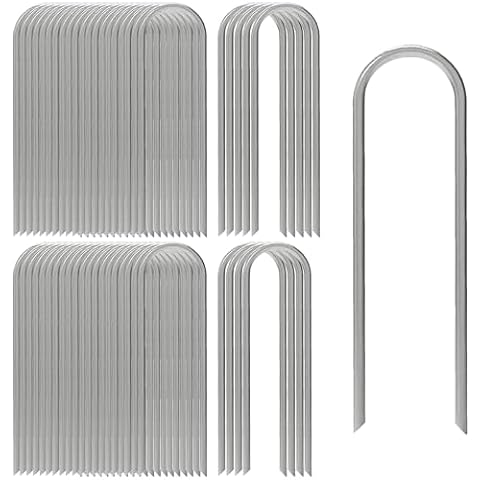
A plain, unglamorous product that's genuinely load-bearing for the apron method: 12" galvanized stakes long enough to actually pin hardware cloth flat against real soil, sold in a 50-pack sized for a full run perimeter rather than a handful of landscape-fabric pins.
- Type: Ground stake / apron anchor
- Material: 11-gauge (3.0mm) hot-dip galvanized steel, U-shaped, chisel-pointed
- Spec: 12" length, 50 per pack
- 12" length is long enough to pin a horizontal apron flat against real ground, not just decorative landscape fabric
- 50-pack covers a full apron perimeter around a mid-size run without running out partway through
- Chisel-pointed ends go in by hand or with a hammer, no separate tool required
- Anchors hardware cloth against the ground — it doesn't replace a buried trench where digging pressure is high; this guide's own how-to notes a trench is generally considered more effective than a surface apron against a determined digger
- 11-gauge steel bends on rocky or heavily compacted soil; not a substitute for a masonry anchor on hard ground
Ideal for: Pinning a horizontal hardware-cloth apron flat to the ground around a run's perimeter — the practical alternative where digging a full trench isn't feasible.
AAGUT 12" Galvanized Ground Stakes, 50-Pack
Predator Hardware
$ see current price on Amazon
A plain, unglamorous product that's genuinely load-bearing for the apron method: 12" galvanized stakes long enough to actually pin hardware cloth flat against real soil, sold in a 50-pack sized for a full run perimeter rather than a handful of landscape-fabric pins.
Check Price on Amazon (paid link)
Nite Guard Solar Predator Control Light (4-Pack) — $$
No wiring, no motion sensor to fail
Genuinely different mechanism from a typical "motion-sensor light": it flashes red automatically every night from dusk to dawn (simulating another predator's eyes, per the manufacturer), rather than waiting for motion to trigger — a real distinction from most other coop deterrent lights sold as "motion-activated," which can also be false-triggered or missed depending on sensor placement.
- Type: Predator deterrent light
- Material: Solar-charged LED unit, weatherproof housing
- Spec: Automatic dusk-to-dawn red LED flash (not motion-activated); no batteries or wiring; manufacturer states night animals are deterred at 500 yards or more
- Fully automatic dusk-to-dawn operation — no motion sensor that can fail to trigger or false-trigger on wind/foliage
- Solar-charged, no batteries to swap and no wiring to run to a run/coop that doesn't have power
- 4-pack is enough to mount one per side of a coop/run perimeter, matching the manufacturer's own spacing guidance rather than leaving sides uncovered
- This is a deterrent, not a barrier — it doesn't replace hardware cloth, latches, or a closed door; a predator that isn't spooked by it faces no other obstacle from this product alone
- Effectiveness against a given animal isn't guaranteed or independently lab-tested; treat it as a genuine added layer, not a proven substitute for the physical layers above
- Needs a reasonable amount of ambient dusk/dawn light to charge; deep shade under trees or a covered run can shorten runtime
Ideal for: An additional deterrent layer alongside real exclusion hardware, especially at a coop/run with no power run to it for a wired light or camera.
Mounting: Manufacturer install guidance: one unit per side of the coop/run, spaced roughly 25-50ft apart, mounted at the target predator's eye level (about 10-15in off the ground for raccoons/foxes/skunks — higher for coyotes/larger predators) and facing outward, away from the flock, not inward.

Nite Guard Solar Predator Control Light (4-Pack)
Predator Hardware
$$ see current price on Amazon
Genuinely different mechanism from a typical "motion-sensor light": it flashes red automatically every night from dusk to dawn (simulating another predator's eyes, per the manufacturer), rather than waiting for motion to trigger — a real distinction from most other coop deterrent lights sold as "motion-activated," which can also be false-triggered or missed depending on sensor placement.
Check Price on Amazon (paid link)
Putting it together: a practical shopping checklist
- Measure before you buy wire. Walk the run's wall perimeter (and roof, if it's open-top) with a tape measure, then add 12–18 inches of width if you're planning a horizontal apron rather than a trench. A single 100ft roll covers most single-run projects; a larger or multi-section run may need a second roll.
- Check the gauge number, not just the mesh size. See the gauge note above — 19-gauge or heavier is the standard this guide uses; thinner gauges are sold under near-identical listing titles.
- Cover every opening, not just the walls. Vents, windows, and the run's roof need the same 1/2" hardware cloth as the perimeter fence — a predator will find the weakest opening, not necessarily the most obvious one.
- Screw or staple it down properly. Exterior screws with fender washers, or heavy-duty galvanized fencing staples every few inches (not just at the corners) — a hardware-cloth roll is only as strong as what's holding its edges down.
- Mount latch hardware in pairs, and add a carabiner. A single slide bolt is still a single motion a raccoon can learn — install one at the top of the door and one at the bottom, and clip a carabiner through the bolt's loop for real added resistance, not the bolt alone.
- Anchor the apron into real soil, not just decorative pins. Ground stakes need to be long enough (roughly 12 inches) to hold hardware cloth flat against dirt under digging pressure — short landscape-fabric pins aren't built for that job.
- Mount a deterrent light at the predator's eye level, facing outward. Per the manufacturer, that's roughly 10-15 inches off the ground for raccoons/foxes/skunks (higher for coyotes), one unit per side of the run, spaced 25-50 feet apart — not aimed at the flock, aimed away from it.
Frequently asked questions
Is chicken wire safe to use for a chicken run?
Not for keeping predators out. Chicken wire (the lightweight, twisted hexagonal mesh) is built to keep chickens contained, not to exclude anything trying to get in — its thin gauge and open weave can be torn or bitten through by a raccoon or dog, and the opening is often large enough for a raccoon to reach through and grab a bird standing near the wire. See our predator-proofing guide for the full explanation of why welded hardware cloth is the recommended swap.
How much hardware cloth do I need for a chicken run?
Measure your run's actual wall perimeter, plus its roof if it's open-top, plus roughly 12-18 inches of width for a horizontal ground apron if you're not trenching. A single 48in x 100ft roll covers most single-coop, single-run projects with material left over for vents and touch-ups — but a large or multi-section run can need more than one roll, so measure before you buy rather than assuming one roll is enough.
Do I need to bury hardware cloth, or is a surface apron enough?
A buried vertical trench (roughly 12 inches deep) is generally considered the more effective option against a determined digger like a fox, and it's what university extension sources most consistently recommend. A horizontal surface apron — hardware cloth laid flat and pinned to the ground, extending out from the run — is a widely used alternative where trenching isn't practical, and it still works on the same principle: a digging animal hits wire before it gets under the fence line. Ground stakes long enough to actually anchor into soil (not just landscape fabric) matter either way.
Are predator deterrent lights like Nite Guard actually effective?
There's no independent lab study confirming a specific effectiveness rate, and this guide isn't claiming one. What's verifiable is the mechanism: a dusk-to-dawn flashing light is a genuine, low-cost added deterrent layer that doesn't depend on wiring or a motion sensor that can fail to trigger. Treat it as exactly that — one more layer stacked on top of real exclusion hardware (wire, latches, a secure door), never a replacement for any of them.